

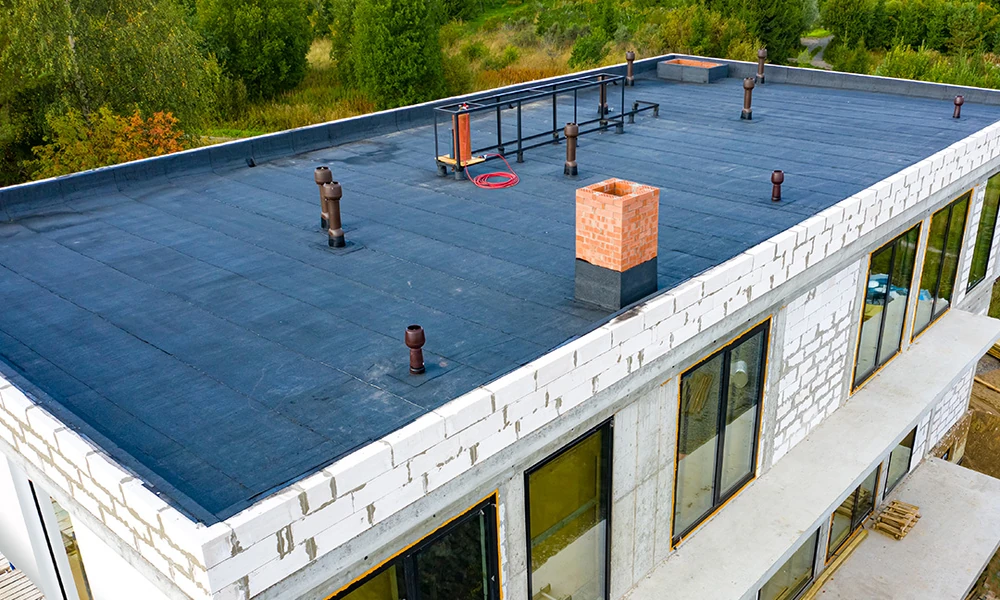
Flat roofs have a reputation problem. Ask around and someone will tell you they always leak, that water just sits there, and that you should expect trouble every few years. Part of that is true for roofs that were designed or installed poorly. A well built low slope roof can perform for decades, and the reasons it succeeds or fails are easier to understand than most owners think.
Searches for Everywhere flat roofing usually go up after the first heavy storm of the season, when a stain shows up on a ceiling tile or a puddle on the roof refuses to dry. Those moments push owners to learn how these roofs work. Knowing that before something goes wrong makes it much easier to judge any repair or replacement proposal.
The short answer to the title question is yes. A flat roof can stay dry for a very long time, but only when slope, membrane, seams and edge details work together as one system.
Flat Is Never Truly Flat
The word “flat” is misleading. A properly designed low slope roof still pitches toward drains, scuppers or gutters, typically about a quarter inch of fall per foot. On new construction that slope may be built into the framing. On older buildings it often comes from tapered insulation boards cut to direct water where it needs to go.
When that slope is missing or has settled over time, water ponds. Many roofing professionals use a simple rule of thumb: water still standing about 48 hours after rain points to a drainage problem. Ponding speeds up membrane aging, adds weight to the structure and makes any small seam defect a much bigger one, because the water simply has nowhere else to go.
Crickets and saddles help too. These small raised sections sit behind rooftop units and between drains, steering water around obstacles instead of letting it collect against them.
The Membrane Is Only Part of the Story
Most of the flat roof conversation centers on which membrane to choose. It matters, but each option has its own strengths.
TPO
Thermoplastic polyolefin has become one of the most common single ply membranes on commercial buildings. Its seams are welded with hot air, which fuses the sheets into one continuous surface instead of relying on glue. It usually comes in white, which reflects sunlight well. Formulations differ between manufacturers, so the specific product and its thickness matter as much as the label.
PVC
PVC membranes are also heat welded and reflective. Their big advantage shows up on restaurants and some industrial buildings, because PVC resists grease, oils and many chemicals that can break down other membranes. It typically costs more than TPO, and that cost buys resistance in harsh conditions.
Modified Bitumen
Modified bitumen is the descendant of traditional built up roofing. It goes down in layers, either torch applied, cold adhered or self adhered. The multiple plies and granulated cap sheet make it tough under foot traffic, which helps on roofs that see regular service visits. It holds heat more than white single ply unless it has a reflective cap or coating.
EPDM rubber still appears on many older buildings and some homes. It is durable and flexible, though its seams are taped rather than welded.
Where Leaks Really Begin
Water rarely gets in through the middle of a healthy membrane. Most leaks start at transitions, where the roof meets something else.
Perimeter edges and parapet walls are frequent problem spots. Flashing that climbs up a wall can pull loose as the building expands and contracts. Pipe boots, HVAC curbs, skylights and vent stacks each create a hole that has to be sealed perfectly. Drains clog with leaves and debris, and when they back up, water rises above the level the flashing was built to handle.
Seams come next. A heat welded seam that was done with the wrong temperature or speed can look fine on install day and open up years later. This is why experienced crews probe seams during installation rather than trusting appearance.
A Simple Twice a Year Check
Owners and property managers can catch a lot of trouble early with a routine walk after the coldest and hottest months:
- Clear drains, scuppers and gutters of leaves and debris.
- Look for standing water and note where it collects.
- Check flashing at walls, curbs and pipes for gaps or lifting.
- Look for blisters, wrinkles or punctures in the membrane surface.
- Inspect ceilings and upper walls inside for new stains.
Photos taken from the same spots each time make it easier to see slow changes, and they help any contractor diagnose problems faster.
Heat, Reflectance and Cool Roofs
Flat roofs take full sun all day, which is why surface color matters so much. According to the U.S. Environmental Protection Agency, low slope roofs can be made cooler with reflective single ply membranes, cap sheets with reflective granules, light colored coatings or pale aggregate. Lower surface temperatures can reduce cooling demand and lessen the thermal stress that ages a membrane.
There is a maintenance side to this. Dirt and debris dull a reflective surface over time, so periodic cleaning keeps a white roof performing like a white roof. In colder climates the winter heating penalty is usually small compared with summer savings, especially when the building is properly insulated.
Repair, Recover or Replace
When a flat roof starts having problems, the decision usually comes down to three paths. Isolated issues like a failed pipe boot or a split seam are good repair candidates. If the membrane is aging but the insulation below is still dry, a recover or a restorative coating may extend its life considerably. When moisture has soaked the insulation or the deck, replacement becomes the sensible choice, because trapped water keeps causing damage no matter what goes on top.
A moisture survey usually settles the question. Infrared scans and small test cuts show what is happening under the surface, which keeps owners from paying to cover up a problem that will come back.
A Roof That Works as a System
Flat roofs earned their bad reputation one shortcut at a time: missing slope, rushed seams, flashing that was an afterthought. Built carefully and looked after with a little routine attention, they are among the most practical roofs for commercial buildings and modern homes. A dry flat roof isn’t luck. It comes from drainage, materials and details that were all planned together.
