

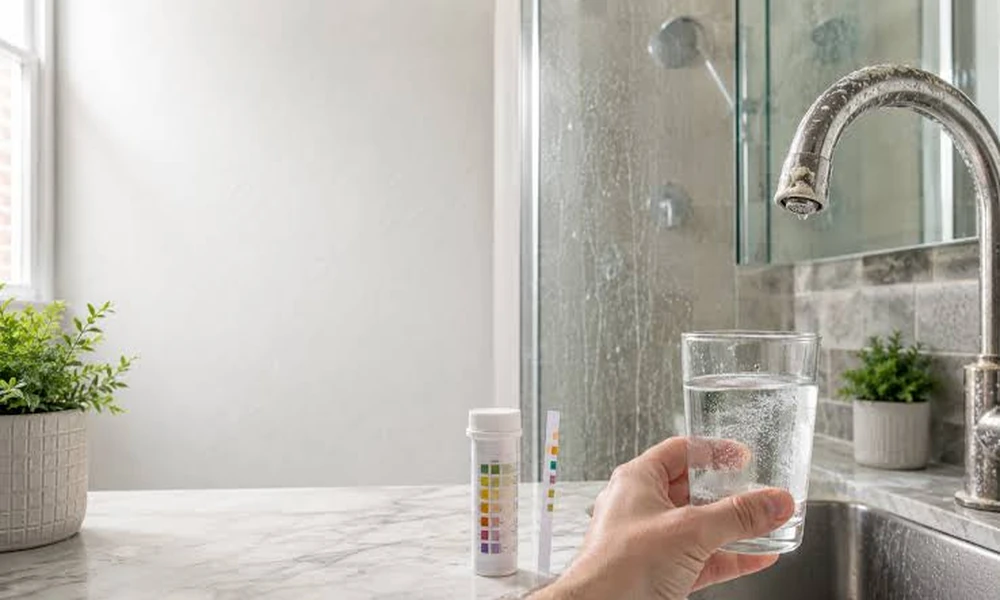
If you have ever scrubbed white crust off a faucet or wondered why your glasses come out of the dishwasher cloudy, you have met hard water. It is one of the most common household complaints in the Madison area, and it is easier to understand than it sounds. Five numbers tell most of the story.
Whether you are curious about a softener, a water heater or simply a leaky faucet, a local plumber such as 4 Lakes Plumbing can explain what hard water means for your particular pipes. Until then, here is a short tour of the numbers behind the minerals.
Number One: 16 to 24 Grains Per Gallon
Water hardness is measured in grains per gallon, often shortened to gpg. According to the Madison Metropolitan Sewerage District’s guide to water hardness and softening, Madison’s drinking water comes from deep groundwater that picks up calcium and magnesium from dolomite rock. Water Utility water typically runs 16 to 24 gpg, though it can range from about 15 to 32 depending on which well supplies your neighborhood.
The district notes that these minerals are not harmful to health. The issue is what they do to pipes, appliances and soap.
Number Two: 10.5 Grains Per Gallon
This is the line where water becomes very hard. By the scale the district cites from the U.S. Geological Survey, water under 3.5 gpg is soft, 3.5 to 7 is moderately hard, 7 to 10.5 is hard, and anything above 10.5 is very hard.
Madison water sits well above that top line. If you are comparing it to other places, it helps to know that Lake Michigan water is about 7.5 to 8 gpg, which the district calls borderline hard.
Number Three: 3 to 4 Grains Per Gallon
If hard water causes scale, you might assume the goal is zero. Not quite. The district says a low level of about 3 to 4 gpg may protect water heaters by leaving a thin layer of scale. Fully soft water is not required, and that is why many households choose to leave some hardness in the water.
A blending valve is one way to do it. It mixes softened and unsoftened water so you can choose your home’s hardness level, and the district recommends it.
Number Four: 50 to 75 Percent
That is how much less detergent the district says laundry needs when it is washed in soft water. Hard water also leaves residue on dishes and clothes and reduces soap lather, which is why many people notice the difference in the shower and the dishwasher first.
Scale builds up more readily in hot water, and it can reduce flow and appliance efficiency. Inside a water heater, it can act as a barrier between the heating element and the water, which can lower efficiency, shorten the unit’s life or raise energy use. Some appliance warranties even set a maximum hardness limit, so it is worth checking yours.
Number Five: 8 to 12 Years
That is the typical lifespan of a water heater, according to the blog on the 4 Lakes Plumbing website. Scale is one of the reasons a heater can age faster in hard-water areas, so if yours is approaching the end of that range, it is a good moment to ask about replacement and about water treatment together.
A Note About Salt
Softeners work by swapping calcium and magnesium for sodium from salt. During regeneration, the rinse water carries chloride into the sewer. The district says the wastewater plant is not designed to remove dissolved chloride, so it passes through to local streams, and it calls softeners the largest salt source to the sewer system.
The district suggests using the lowest salt setting that works, choosing a demand-initiated regeneration unit that tracks actual use, and using a blending valve. It also notes that potassium chloride is not a better choice here because it still contains chloride.
Questions to Ask Before You Buy
- What is the hardness at my address, in grains per gallon?
- Is the softener demand-initiated or timer-based?
- Does it include a blending valve?
- How much salt will it use?
- Does my water heater warranty set a hardness limit?
- How old is my water heater now?
The Takeaway
Hard water is not a mystery, and it is not an emergency. Know your number, protect your water heater, and choose a softener setup that treats the water you need and no more. A few simple facts will save money and keep your plumbing running smoothly.
